
Most people think of hearing impairment as just a nuisance—a little harder to follow conversations, maybe turning the TV up a notch or two. But a growing body of medical research, along with clinical insight from Dr. Mark Nichols, ENT, is telling a very different and far more serious story.
Leaving sensorineural hearing loss untreated doesn’t just affect how well you hear. It can quietly unravel your mental health, your social life, and even your brain.
What Is Sensorineural Hearing Loss?
Sensorineural hearing loss is a permanent type of hearing loss caused by damage to the inner ear or auditory nerve, affecting how sound signals are sent to the brain.
Unlike the temporary muffling you might get from an ear infection, sensorineural hearing loss (SNHL) results from permanent damage to the tiny hair cells in the inner ear or the nerve pathways that carry sound to the brain.
It is the most common form of hearing impairment, with sounds perceived as muted and distorted compared to other types of hearing impairment. Once it takes hold, it is progressive and results in permanent damage if left unaddressed.¹
Common hearing loss causes include aging, noise exposure, genetics, and certain medications. Globally, around 5% of the world’s population experiences disabling hearing loss, and the large majority of cases are sensorineural in nature.²

The Dementia Connection: This One Will Surprise You
Perhaps the most alarming finding from recent research is how closely untreated hearing loss is linked to cognitive decline. Multiple large-scale studies published in 2024 and 2025 have sounded the alarm—and the evidence is compelling.
A landmark review published in 2025 by Beck and colleagues, drawing together a wide range of peer-reviewed longitudinal studies, concluded that untreated hearing loss tends to accelerate cognitive decline in people who are already at risk, while professionally fitted hearing aids have been shown to delay or reduce those effects for many patients.
The authors were careful to note that while causation is rarely proven in epidemiological research of this kind—just as we say smoking is strongly correlated with lung cancer rather than proven to directly cause it—the weight of evidence linking untreated hearing loss to dementia risk is substantial and clinically meaningful.³
Among the key studies they highlighted: a long-running French study following 3,670 people over 25 years found that self-reported hearing loss was associated with accelerated cognitive decline, and that hearing aid use measurably reduced that decline.⁴
A UK study of over 82,000 dementia-free adults found that poor performance on speech-in-noise tests was associated with a 61% increased risk of developing dementia over 11 years.⁵
And the landmark ACHIEVE trial, a randomized controlled study published in The Lancet in 2023, found that a hearing intervention program slowed the rate of cognitive decline in older adults who are at risk by 48% over three years.⁶
More recently, a population-level Danish study of over 573,000 people found that hearing loss was associated with significantly increased dementia risk, that the risk rose with severity of hearing loss, and that it was notably higher in those not using hearing aids compared to those who were—suggesting hearing aids may delay or prevent dementia onset.⁷
An 8-year follow-up study using data from the US Health and Retirement Study similarly found that adults over 50 who began using hearing aids had a significantly lower risk of developing dementia than those who did not.⁸
The likely mechanism involves a cascade of effects: when the brain is starved of sound stimulation and social interaction becomes increasingly exhausting, cognitive reserves are depleted. Social isolation reduces mental stimulation and raises the risks of depression and cognitive decline further still.⁹
Key Takeaway: Can hearing loss lead to dementia? Research shows a strong association between reduced hearing and changes in cognitive function over time. Untreated cases are linked to a higher risk of decline, particularly in older adults. |
Hearing Loss and Mental Health
The damage doesn’t stop with cognition.
Research consistently links untreated hearing loss with depression, anxiety, and social withdrawal. Hearing loss makes every conversation harder work. Over time, the mental fatigue of straining to follow speech leads many people to disengage—first mentally tuning out within social situations, and eventually avoiding those situations altogether.¹⁰
Studies have found significant associations between untreated hearing loss and clinically meaningful depression, anxiety, and stress.¹¹
A 2024 Australian study of adults aged 50 and over concluded that untreated hearing loss is a major contributor to mental health symptoms and social isolation, compounding the risk for dementia, and that hearing aid use mitigates some of these effects.¹²
Researchers from Johns Hopkins have also noted that the frustration and embarrassment of difficulty communicating can lead to withdrawal from social events, religious services, and family gatherings—and that this progressive isolation itself represents a pathway to worsened mental and cognitive health.¹³
Key Takeaway: How does hearing loss affect mental health? Struggling to hear clearly can lead to frustration, social withdrawal, and reduced confidence in conversations. Over time, this may contribute to depression, anxiety, and overall emotional strain. |
The Physical Risks Too
The consequences extend beyond the mind. Age-related hearing loss is linked to a range of serious physical health conditions, including:
- Cardiovascular disease
- Diabetes
- Inflammatory disease
- Chronic kidney disease
- Vestibular dysfunction
- A heightened risk of falls¹³
Falls in older adults, of course, are a leading cause of serious injury and hospitalization.
For people who experience sudden sensorineural hearing loss—where hearing drops rapidly, sometimes literally overnight—the stakes of inaction are especially high. If left untreated, this condition can result in permanent hearing impairment.
Research consistently shows that delayed hearing loss treatment is one of the strongest risk factors for poor recovery, meaning the window to act is short.¹⁴
Key Takeaway: What physical health risks are linked to hearing loss? Hearing loss is associated with conditions like cardiovascular disease, diabetes, and an increased risk of falls. In sudden cases, delaying treatment can lead to permanent impairment, making early care important. |
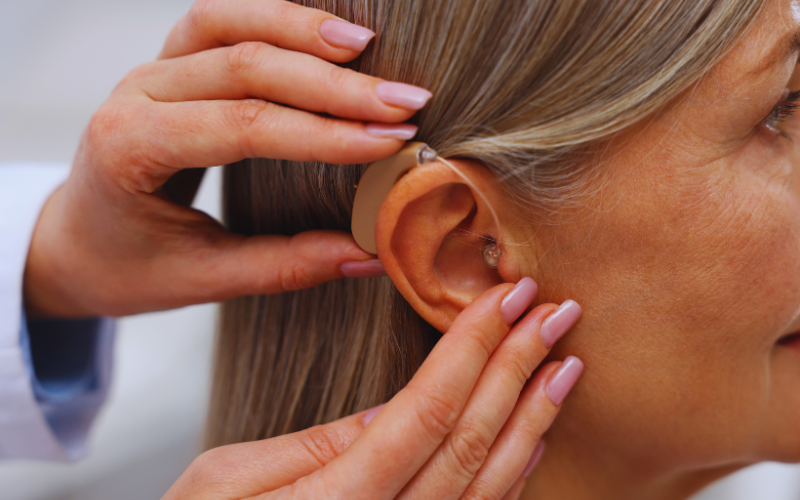
So What Can Treatment Actually Do?
The good news is that the evidence on treatment is genuinely encouraging. Hearing aids are the most widely available intervention, and their benefits go well beyond simply hearing better.
A 2025 study from Keck Medicine of USC, published in JAMA Otolaryngology –
Head & Neck Surgery, conducted a systematic review and meta-analysis of 65 previously published studies covering more than 5,000 participants.
It found that adults with hearing loss who used hearing aids or cochlear implants (compared to those who went untreated):
- Were more socially engaged
- Felt less isolated
- Reported fewer barriers in social situations
- Experienced improved confidence in conversations
The researchers found that people using hearing devices:
- Were better able to follow group conversations
- Felt less excluded in noisy environments
- Reported stronger feelings of belonging
- Experienced reduced social anxiety
Those with cochlear implants showed the greatest improvement, likely because they restore hearing more substantially in cases of severe loss.¹⁵
This research followed a 2024 study from the same team showing that adults with hearing loss who use hearing aids have an almost 25% lower risk of mortality compared to those who do not—suggesting that treating hearing loss may help people live longer, not just better.¹⁶
For those with depression linked to hearing loss, the benefits of treatment can come quickly: some studies have reported reductions in depressive symptoms within just three months of starting regular hearing aid use.¹³
Cochlear implants offer a more powerful solution for those with severe or profound hearing loss, bypassing the damaged parts of the inner ear to directly stimulate the auditory nerve.
Emerging therapies offer further hope. Gene therapy has recently demonstrated hearing restoration in children with certain genetic forms of hearing loss,¹⁷ and stem cell research targeting inner ear regeneration is advancing, though not yet available as a standard treatment.²
Key Takeaway: How can treating hearing loss improve overall health? Treatment can improve more than just hearing by helping people stay socially engaged, feel less isolated, and communicate with greater confidence. It may also support mental well-being, reduce anxiety, and has been linked to better long-term health outcomes, including a lower risk of decline and improved quality of life. |
Take the Next Step Toward Better Hearing and Brain Health
Hearing loss is not a minor inconvenience to be brushed off or quietly adapted to. The latest research shows that leaving sensorineural hearing loss untreated can impact memory, mood, social connection, and overall health.
Acting early can make a meaningful difference in long-term outcomes. If you’ve noticed changes like difficulty following conversations, frequently asking others to repeat themselves, or needing higher volume levels, it may be time to take the next step.
At ENT & Allergy Associates, our hearing loss and hearing aid specialists provide comprehensive evaluations and personalized care plans to address hearing concerns at every stage. With convenient locations across New York, New Jersey, Pennsylvania, and Texas, expert care is always within reach.
Take control of your hearing health today by booking an appointment online with a team that understands how closely hearing, brain function, and quality of life are connected.
This article is for general informational purposes only and is not a substitute for professional medical advice.Sources:
Stojkovic T, et al. Recent therapeutic progress and future perspectives for the treatment of hearing loss. Cells. 2023;13(1):21. doi:10.3390/cells13010021
Stojkovic T, et al. Current and emerging approaches to cochlear immunology and sensorineural hearing loss. PLoS One. 2024. doi:10.1371/journal.pone.0318165
Beck DL, Darrow KN, Ballachanda B, et al. Untreated hearing loss, hearing aids, and cognition: correlational outcomes 2025. Kirsch Audiology / Audiology Online. Published March 6, 2025. Available at: https://kirschaudiology.com/ untreated-hearing-loss-hearing-aids-and-cognition-correlational-outcomes-2025
Amieva H, Ouvrard C, Giulioli C, Meillon C, Rullier L, Dartigues JF. Self-reported hearing loss, hearing aids, and cognitive decline in elderly adults: a 25-year study. J Am Geriatr Soc. 2015;63(10):2099-2104. doi:10.1111/jgs.13649
Stevenson JS, Clifton L, Kuźma E, Littlejohns TJ. Speech-in-noise hearing impairment is associated with an increased risk of incident dementia in 82,039 UK Biobank participants. Alzheimers Dement. 2022;18(3):445-456. doi:10.1002/alz.12416
Lin FR, Pike JR, Albert MS, et al; ACHIEVE Collaborative Research Group. Hearing intervention versus health education control to reduce cognitive decline in older adults with hearing loss in the USA (ACHIEVE): a multicentre, randomised controlled trial. Lancet. 2023;402(10404):786-797. doi:10.1016/S0140-6736(23)01406-X
Cantuaria ML, Pedersen ER, Waldorff FB, et al. Hearing loss, hearing aid use, and risk of dementia in older adults. JAMA Otolaryngol Head Neck Surg. 2024;150(2):157-164. doi:10.1001/jamaoto.2023.3509
Wei J, Li K, Kim Y, et al. Initiation of hearing aid use and incident dementia among mid-to-late life adults: the Health and Retirement Study 2010-2018. J Geriatr Psychiatry Neurol. 2024. doi:10.1177/08919887241302107
Grullon J, Gutierrez J, Luchsinger JA, et al. Elucidating the relationship between hearing loss, social isolation, and dementia: data from the National Health and Aging Trends Study. J Gerontol B Psychol Sci Soc Sci. 2026;81(3):gbaf276. doi:10.1093/geronb/gbaf276
Motala A, Johnsrude IS, Herrmann B. A longitudinal framework to describe the relation between age-related hearing loss and social isolation. Trends Hear. 2024;28:23312165241236041. doi:10.1177/23312165241236041
Jayakody DMP, Friedland PL, Martins RN, Sohrabi HR. Is there an association between untreated hearing loss and psychosocial outcomes? Front Aging Neurosci. 2022;14:868673. doi:10.3389/fnagi.2022.868673
Hamrah MS, Mond J, Hiller JE, Sim MR. Hearing loss, social isolation and depression in participants aged 50 years or over in Tasmania, Australia. Australas J Ageing. 2024. doi:10.1111/ajag.13363
Reed NS, Assi L, Bhatt J, et al. Hearing loss, loneliness, and social isolation: a systematic review. Otolaryngol Head Neck Surg. 2020;162(5):622-633. doi:10.1177/0194599820910377
Chen N, et al. Analysis of the reasons for poor prognosis in severe to profound sudden sensorineural hearing loss: a systematic review and meta-analysis. Diagnostics (Basel). 2025;15(21):2770. doi:10.3390/diagnostics15212770
Choi JS, et al. Hearing aids and cochlear implants and their association with social quality of life, social handicap, and loneliness: a systematic review and meta-analysis. JAMA Otolaryngol Head Neck Surg. Published July 3, 2025. doi:10.1001/jamaoto.2025.1777
Choi JS, et al. Hearing aid use and the risk of all-cause mortality. JAMA Otolaryngol Head Neck Surg. Published January 2024. doi:10.1001/jamaoto.2023.4732
Qi J, et al. Gene therapy approaches for sensorineural hearing loss: recent advances and future perspectives. Front Audiol Otol. 2024. doi:10.3389/fauot.2024.1423853