
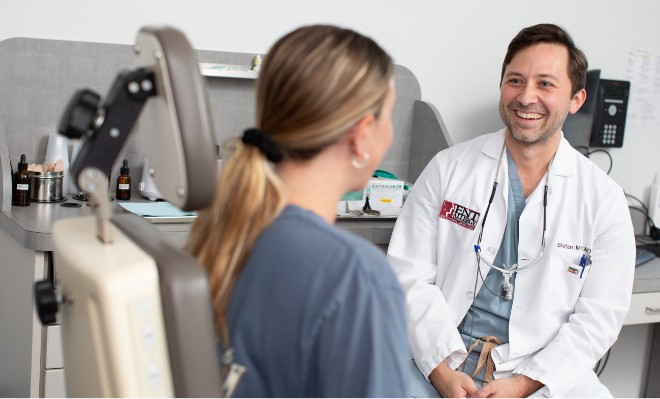
Audiology evaluations consist of a series of tests used to determine whether a hearing loss exists and, if so, measure its type, degree and configuration. An audiologist will assess the results of each individual test in order to develop a treatment plan geared toward your unique hearing loss.
Who Should Be Given an Audiology Evaluation?
An audiology (or hearing) evaluation can benefit patients of all ages, even those who do not exhibit signs of hearing loss.
Hearing loss is a progressive condition that often develops slowly. Many people are not aware of a change in their hearing because they gradually adapt to the subtle changes in their hearing ability over time. Studies indicate that it takes seven years, on average, for a hearing impaired individual to seek treatment.
An audiology evaluation should be the first course of action for anyone who suspects a hearing loss. The sooner a diagnosis of hearing loss is made, the more successful treatment will be. Early detection means more options for the patient.
Many physicians urge making audiology evaluations a routine part of your overall health care, much like regular vision exams and dental checkups. They are quick, painless and provide immediate results.
A comprehensive audiology evaluation consists of a series of individual diagnostic tests that measure different aspects of your hearing. Following a physical examination and a review of your medical history, you will be given any or all of the following tests:
Pure Tone Testing
Pure-tone testing (also known as pure tone audiometry) uses air conduction to measure your ability to hear sounds of various pitches and volumes. Wearing headphones, you will be asked to identify a series of tones by raising a hand, pressing a button, or responding verbally.
The results are charted on an audiogram, a graph that shows the type, degree and configuration of your hearing loss by comparing pitch (frequency) with loudness (intensity). The pattern recorded will help your audiologist determine your hearing threshold.
Bone Conduction Testing
Bone conduction hearing testing is another type of pure-tone test that measures the inner ear’s response to sound. If there is damage or a blockage in the outer or middle ear, bone conduction audiometry testing may be used.
Instead of sending the tones through the ear, this type of hearing testing is able to bypass the outer and middle ear and send the tone directly to the inner ear. A small device is placed behind the ear and uses vibration to transmit sounds.
If the results of this test are different than the air conduction test, your audiologist can use this information to determine whether you have a conductive or sensorineural hearing loss.
Some of our hearing test physicians use a two-pronged metal tuning fork to help diagnose types of hearing loss. The tuning fork is placed behind the ear or on the forehead and, when vibrated, produces a tone that travels to the cochlea via the skull. Your response determines how well sound travels through different parts of your ear.
Speech Testing
Speech (or word recognition) hearing testing is used to measure your speech reception threshold (SRT), or the faintest speech you can understand 50 percent of the time. This is compared with your pure-tone test results to confirm the diagnosis. In addition, your ability to separate speech from background noise will be recorded.
Speech testing may be administered in either a quiet or noisy environment; results are recorded on the audiogram for easy visual reference.
Tympanometry
Tympanometry is a test of the middle ear used to detect fluid, wax buildup, eardrum perforations and tumors. It measures movement of the eardrum in response to air pressure. The results are recorded on a chart called a tympanogram.
Acoustic Reflex Testing
The acoustic reflex test measures involuntary muscle contractions of the middle ear, and is used to determine the location of your hearing problem (the ossicles, cochlea, auditory nerve, etc.) as well as the type of hearing loss.
Auditory Brainstem Response (ABR)
Auditory brainstem response hearing testing is used to determine whether a specific type of hearing loss – sensorineural – exists. It is also frequently used to screen newborns for hearing problems.
In an ABR test, electrodes are attached to your head, scalp or earlobes, and you are given headphones to wear. Your brainwave activity is measured in response to sounds of varying intensities.
Otoacoustic Emissions (OAEs)
Otoacoustic emissions (OAEs) are sounds generated by vibrations of the hair cells in the cochlea of the inner ear. OAE testing utilizes a tiny probe fitted with a microphone and speaker that is used to stimulate the cochlea and measure its response. Individuals with normal hearing will produce emissions; when a hearing loss exceeds 25-30 decibels, no sound will be produced.
This test helps determine whether there is a blockage in the ear canal, excess fluid in the middle ear or damage to the hair cells of the cochlea. OAE testing is often included in newborn hearing screening programs.
Schedule a Hearing Test Near You
If you have noticed changes in your hearing or simply want to stay proactive about your ear health, a hearing evaluation is an important step. Our audiology teams across New York, New Jersey, and Texas provide comprehensive hearing tests for patients of all ages, helping you understand your hearing clearly and confidently. Contact us today to schedule your hearing test and take an important step toward better hearing health.

Dedicated to Providing Convenient and Exceptional Care

Patient Stories
-
"I have been a patient of Dr. Scher in Wayne for over 10 years. He’s truly a personable, skillful, and caring physician. As a person with lifelong hearing/ear issues, it’s so important (and such a relief) to find a doctor you trust and an office staff you like. I can’t imagine ever going anywhere else!"
- Suzanne M. -
"Dr. Sreepada is an amazing doctor. He is very knowledgeable, professional & in addition he cares about his patients. He always gets me better in a hurry & he always calls me to follow up to see how I’m feeling. His staff is great and calls me back within 1/2 hour. Thanks for it all!!"
- Debra L. -
"As usual, Dr Sreepada is the most professional, courteous, yet down to earth doctor I've seen. He listens and recommends several choices for treatment. He has helped me with both sleep and seasonal allergy issues. Plus, my wife says he's very handsome too. Never have to wait, if at all for my appointments. Great choice!"
- Randy T.
Less Sick Days, More Living